

Caregiving for a loved one can be overwhelming, exhausting, stressful, and lonely. Whether you’re caring for an aging parent, a child with disabilities, or a family member who’s struggling physically or mentally, it can take a lot out of you.
Self-care for caregivers can easily fall to the wayside when you’re in the thick of it.
My dad is 87 and is living with Parkinson’s. His hearing is shot, his eyes are failing, and his body is betraying him. He is stubborn as all get out and can be frustrating as hell.
But he is also a great dad, and I love him to death. Every day, he shares his wisdom and knowledge, making me a little bit smarter than I was yesterday.
I have been his primary caregiver for the last two years, but in all honesty, I have been doing it in a lesser form for about 6 years, if not longer.
I have lived next door to him for the last 17 years. That means I am on the front lines for everything that happens, the good, the bad, and all of the “Are you fuckin’ kidding me?” moments.
When I read stories from other caregivers, I often see that the person they’re caregiving for doesn’t want to do things themselves anymore.
I have the opposite problem; my dad thinks he can still go outside and do things he just can’t or shouldn’t be doing anymore.
Both scenarios create a different kind of stress for the caregiver—but they land in the same place: constant mental overload.
In the first one, you’re constantly bombarded with demands to get them this or to go do that, and sometimes it’s not always in a nice way.
In the second, you’re constantly watching and waiting for your loved one to decide that they’re going to do something that could put their safety at risk.
For me, that means I’m always waiting to hear the lawn tractor fire up. It’s my dad’s wheels for getting around our yards (2 acres-ish), and he also still likes to get out there and cut grass.
But, he gets himself into trouble when he tries to do shit outside; things like getting the lawn tractor hung up on a tree, a cement pad, or once between a tree and a fence. And let me tell ya, that damn lawn tractor isn’t light!
He also tends to get down on the ground to fix something, or at times, he just lies down because he needs a rest. Of course, once he’s down there, he can’t get himself back up. I guess I should be thankful that he is doing a decent job of keeping me in shape—kind of.
Not gonna lie, the last couple of months have been slowly chipping away at my patience. Usually, I am pretty good about fitting in some self-care when I know I need it, but lately that hasn’t been happening, and it shows.
That’s the thing about caregiving. You can keep shoving your own needs to the bottom of the list for a while, but eventually it will catch up with you.
The importance of self-care for caregivers is no damn joke.
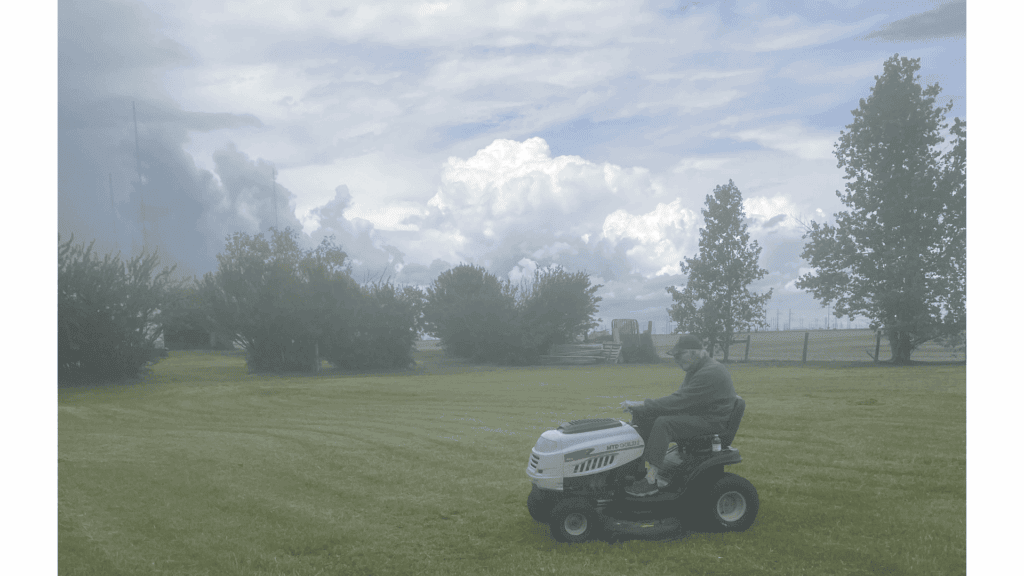
Dad & his wheels, cutting grass in my backyard
Table of Contents
The Toll Caregiving Takes (It Ain’t All Sunshine And Rainbows)
Physical Toll
Caregiving can be damn hard on the body, especially if you’re caregiving for someone who needs to be lifted and transferred often. Continually doing chores around the house or in the yard, like rescuing lawn tractors off of things it shouldn’t have been near in the first place, can take a toll, leading you to have chronic pain or injuries over time.
Emotional Toll
Caregiving can be difficult. You may shift between feelings of love and satisfaction to stress and frustration. It’s emotionally taxing to watch your loved one struggle in their day-to-day life or when that mile-long to-do list just keeps getting longer. It’s easy to slip into sadness, burnout, anxiety, and guilt (for not keeping up and getting shit done).
Social Toll
Caregiving can make you feel isolated. Your day revolves around your loved one in one way or another. You’re on call 24/7, you’re used to dropping whatever you’re doing at a moment’s notice, and your own life shit, well, it gets put at the bottom of that to-do list. When you do finally make that coffee date with a friend, you can never fully enjoy yourself because your caregiving mind never fully shuts off.
Financial Toll
Caregiving can drain your bank account. Many caregivers reduce their work hours or just flat out leave their jobs to care for a loved one. While not everyone is in a position to leave their job, those who do often feel the financial hit. Medical bills, home safety tweaks, and travel expenses can also lead to stress if the caregiver’s loved one doesn’t have the extra funds to cover additional expenses.
When one or more of these things make you feel like you’re spiralling out of control, do your damnedest to carve out some time for self-care, even if it’s only a few minutes.
10 Quick Self-Care Tips For Caregivers (Girl, Make The Time)
Here are a few things you can try when you’re at your wits’ end and not sure you can do it all again tomorrow. I promise they won’t take a ton of your time.
Scream
One of my favorites. Just let all that stress and frustration out. Consider screaming into a pillow if you have neighbours or others living with you.
Vent
Another great way to let your frustrations loose. Let it rip with your best friend, spouse, family member, whoever your person is, just get those frustrations out of your head.
Meditate
Sit quietly and breathe slowly—in and out, clear your mind and just be. Try it for just 5 minutes. It really does help to slow down the emotional rollercoaster.
Dance
Put on your favorite upbeat song and dance your heart out. I find it works best when you belt out the words off-key.
Nature
Step outside for five minutes. Sit on the porch, day or night, or take a quick walk around the block. Just get out there and soak up the beauty around you.
Journal
Get your feelings and frustrations down on paper. A classic self-care outlet, but it works if you like to jot down your thoughts.
Do Nothing
Binge-watch a show, read a trashy book, or just sit in a quiet room staring at the wall. Just do something that takes little to no brain power.
Order In
Screw cooking and the mountain of dishes that come with it. Order your favorite takeout and let someone else do the work tonight.
Ask For Help
If you need help, ask for it. Don’t feel bad about needing help; none of us is immune to needing a helping hand now and then. Stop trying to get it all done yourself, especially if it’s reached an unmanageable level.
Do Something That Makes You Happy
Do the thing that makes you smile and brings joy back into your life, whatever that may be.
The truth is that self-care doesn’t have to be complicated or take hours out of your day.
Want more ideas? Grab my 100 Self-Care Ideas.

Caring For The Caregivers
Caregivers spend so much time making sure everyone else is okay that they often stop checking in with themselves. You get used to pushing through, figuring it out, and handling whatever shit gets thrown your way. But being capable doesn’t mean you’re not tired. It doesn’t mean you’re not overwhelmed. And it definitely doesn’t mean you have to carry everything by yourself.
One thing that often hits hard for caregivers is the feeling that no one has their back, whether that’s coming from the people around them or the pressure they’re putting on themselves.
It’s easy to feel unappreciated by those around you, and it’s equally easy to feel guilty for wanting some time to yourself.
If you’re feeling like nobody cares about how you’re feeling and how you’re coping, speak up. Tell those around you that sometimes it’s just nice to be asked, “How are you doing? Do you need anything? How can I help?”
If you’re feeling like you need to ditch your guilt and do something for yourself, then do it. Stop beating yourself up for needing time to yourself.
Caregiving can be rewarding, but let’s not pretend it isn’t heavy as hell sometimes.
The people we care for need support, absolutely—but caregivers need support too.
So if you’ve been running on empty lately, take five minutes. Step outside. Call a friend. Leave the dishes. Scream into that pillow.
Do whatever you need to do to reclaim a piece of yourself today because you matter, too.
What’s one thing you’ve done recently that helped you recharge, even for a few minutes? Let me know in the comments below!
If You’re Walking The Caregiving Road Right Now
Trust me, I know how easy it is to put yourself at the bottom of the list. I’m still working on it myself.
Whether you’re just getting started on your caregiving journey or have been at it for a while, you might be interested in:
Taking Care of Elderly Parents at Home: A No-BS Guide for Women Who Are Done Pretending This is Easy
Siblings and Elderly Parents: How to Split the Care Without Starting World War III
38 Questions to Ask Your Aging Parents Before It’s Too Late (Don’t Put Off the Hard Shit)
Caregiver Burden Scale Self-Check
Caregiver Task Assignment List
Life can get heavy sometimes. Join the newsletter for practical resources, fresh perspectives, and reminders that you don’t have to figure everything out alone.



0 Comments